
Alembic Cloud Forest Gallery
The images on this page divide into three groups, and it helps to know which you are looking at: the project itself, the drawings that govern it, and the ground immediately around it. Cloud Forest is three towers, A, B and C, of 34 floors each, 105.7 metres tall, holding 798 homes on about 9.38 acres at Pattandur Agrahara, Kadugodi.
The Towers, Seen From Above
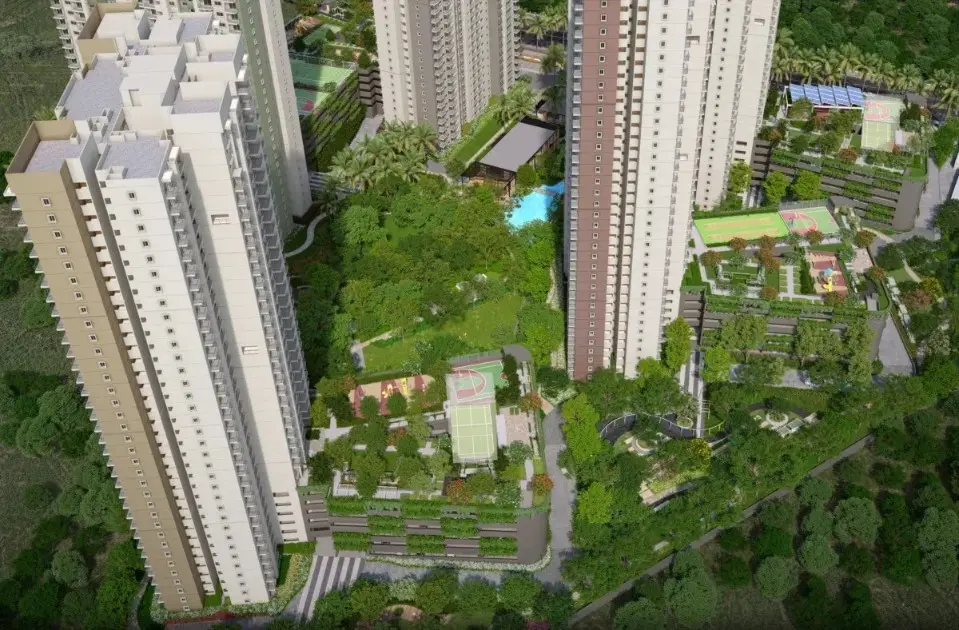
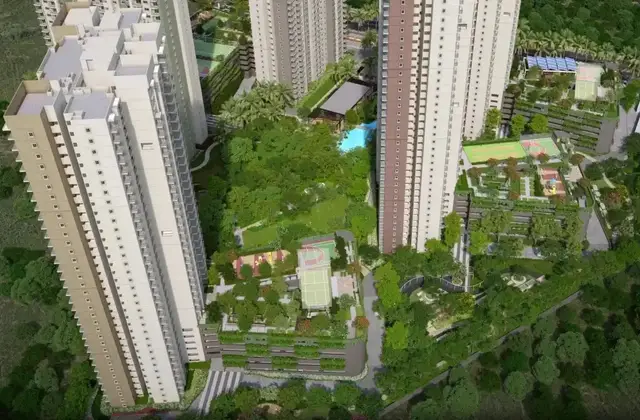
The aerial is the most informative frame in the set, because it shows the thing the elevations cannot: the ground between the buildings. Amberstone Vectra is useful when buyers are reading images for practical signals: light, approach, amenity scale, landscape maturity, and what still needs official confirmation.
Two long slab-form towers run down the left of the frame and a third rises through the centre-right, and between them the parcel reads as woodland rather than as landscaping. A dense canopy of mature trees fills the middle of the site, with a swimming pool tucked under tree cover near the top of the frame and a shaded pavilion beside it. Lower down, an outdoor sports court in red and green sits in a clearing, with a second court and a children's play area on a terraced deck to the right. Stepped planting runs along the podium edges, and a boundary line of heavy tree cover closes the site on the south and east.
The proportion is the point. The towers are slender against the plan area they stand on, and the space they leave is given over to canopy rather than to hard surface. The name is doing what the ground plane does.
A tighter crop of the same aerial frames the central grounds and the courts alone, and is the better image if you want to read the landscape rather than the massing.
The Three Towers at Dusk
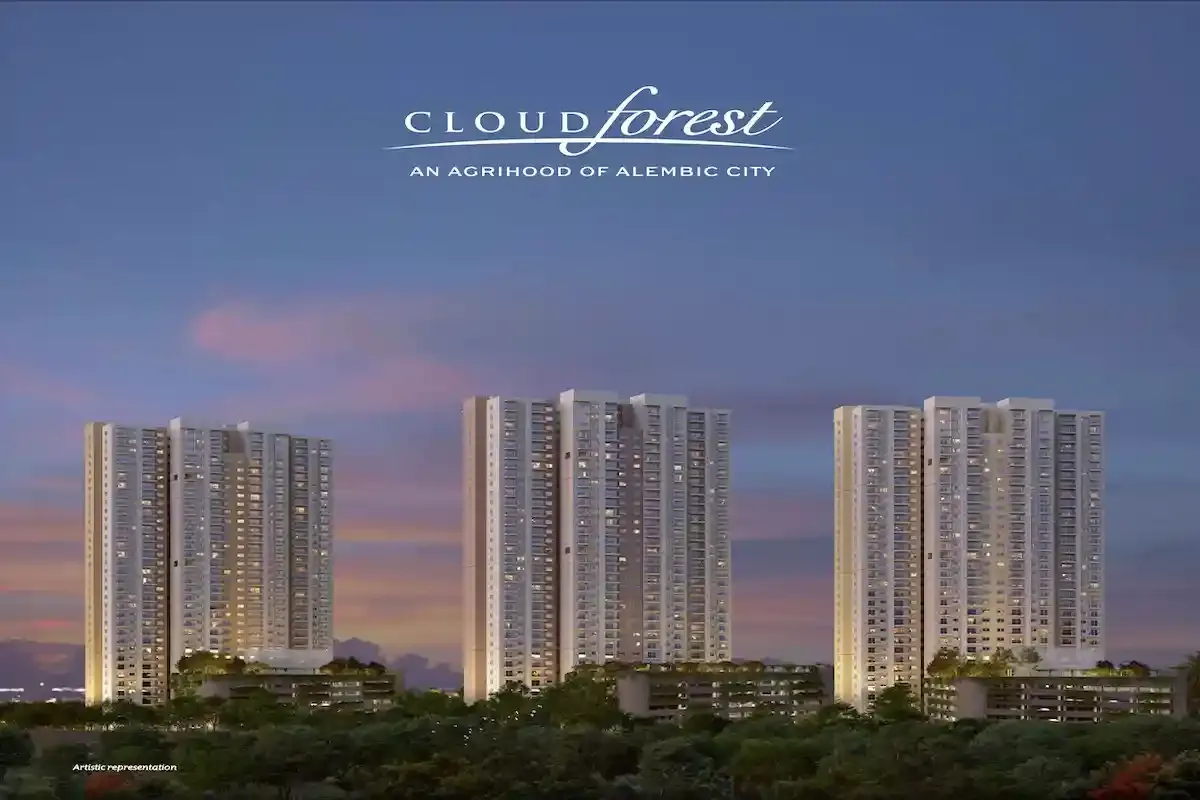
The elevation view shows all three towers standing clear of the treeline at dusk, lit from within, against a sky going from blue to rose at the horizon. Each tower rises from a low podium block set among trees, and the vertical banding of the facade reads clearly at this distance - the tall narrow proportion that 34 floors produces.
Count the towers in this frame. Three, and that is what is registered: Towers A, B and C, 266 homes in each. Where an image and a public register agree, the image is telling you something you can check.
The Pool and the Amenity Terrace
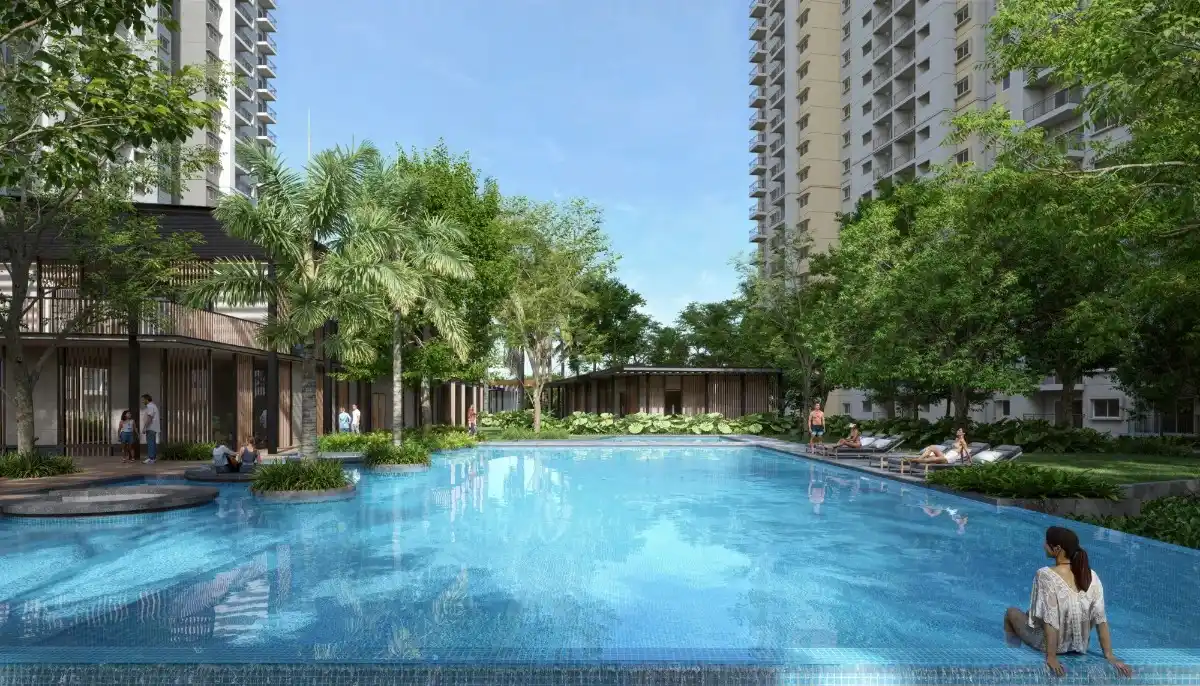
Two frames cover the pool, and between them they describe the whole terrace.
The wider frame looks down the length of a large rectangular pool in blue mosaic, with a sun deck and loungers along the right-hand edge and mature trees overhanging the far end. On the left, a single-storey amenity building in timber and stone runs along the water, its facade broken into vertical timber louvres under a deep flat roof. Two towers rise behind, close enough to be present and far enough back that the terrace does not sit in their shadow.
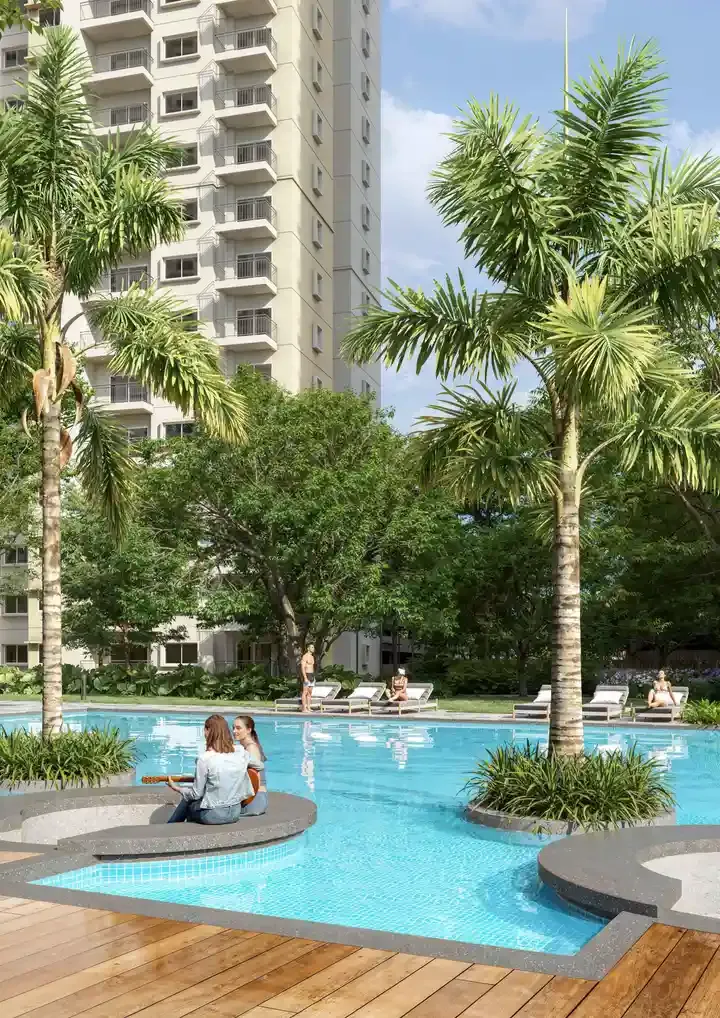
The second frame turns to face across the water. Circular seating islands sit in the shallows with people sitting on them, a broad timber deck runs across the foreground, and tall palms break the view of the tower behind. It is the frame that best answers what this space would actually be used for on an ordinary evening.
A swimming pool is on the project's declared amenity schedule at 310 sq m, which is the figure to hold these images against.
The Arrival Pavilion
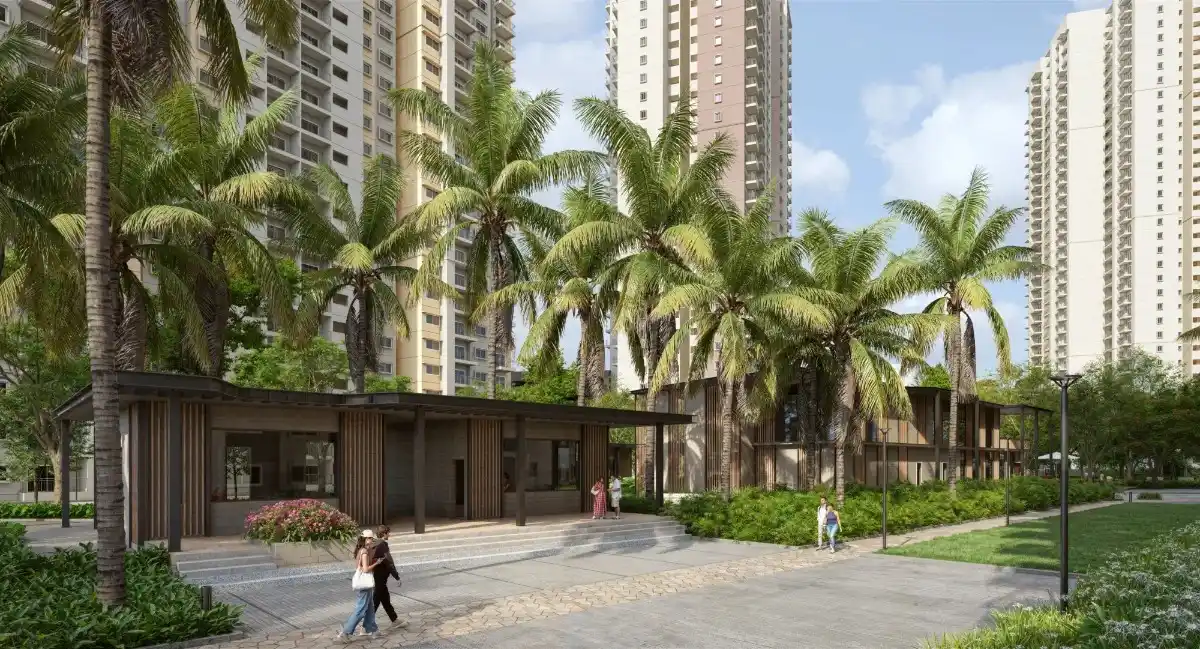
A low pavilion with a deep flat roof and full-height timber screens sits at the end of a paved forecourt, its steps rising from a patterned granite apron. Coconut palms stand across the foreground, lawn runs away to the right past slim black lamp standards, and the towers rise behind in pale stone and cream. People walk across the plaza at the scale of the building, which is the useful part - it tells you the arrival space is generous without being monumental.
The Master Plan
The master plan shows the parcel divided by a yellow boundary line. On one side sits Phase I, with three residential clusters pinned A, B and C - the three towers described above, and the phase that carries the registration. On the other side sit two further clusters, pinned D and E.
Be precise about what that drawing does and does not tell you. The developer's master plan shows two further blocks, D and E. Neither is registered with Karnataka RERA as at September 2026, and no launch date or unit count has been published. Everything a buyer can verify today - the 798 homes, the three towers, the 9.38 acres, the 31 October 2029 completion date - relates to the side of the line marked Phase I. Treat the drawing as the developer's layout of the parcel rather than as a sanctioned scheme, and do not price the far side of the line into your decision.
The Location Map
The location map is the developer's own, and it places the site in the green belt between the Whitefield and Hopefarm Channasandra metro stations, with the surrounding road network, schools and landmarks labelled around it. The Cloud Forest pin sits beside two other labelled areas, Alembic City and Alembic Urban Forest.
The relationship those labels describe is adjacency. Cloud Forest stands next to Alembic City and next to Alembic Urban Forest; the developer's own position is that Alembic City's amenities and plans do not form part of the Cloud Forest offering. Read the map as a guide to the neighbourhood, and read the Cloud Forest boundary as where your entitlements stop.
The registered address is Sy Nos 20, 21, 22, 23, 24/1-3, 25/1-3, 26/1, Pattandur Agrahara Village, K R Puram Hobli, Bengaluru East, Bengaluru Urban 560066, and the registered coordinates are 12.986254, 77.75782. Put those coordinates into a mapping app before you drive out, because more than one pin for this project is in circulation and the registered one is the one that matches the land.
Next Door
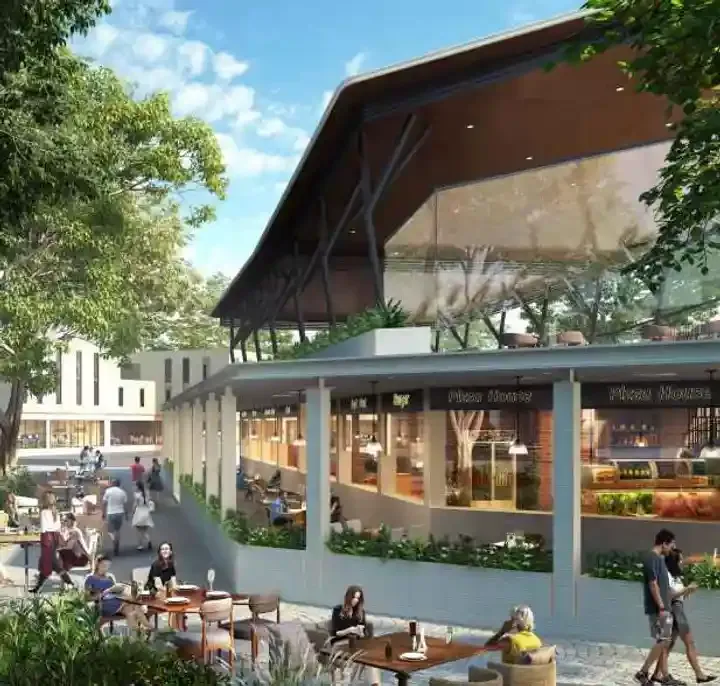
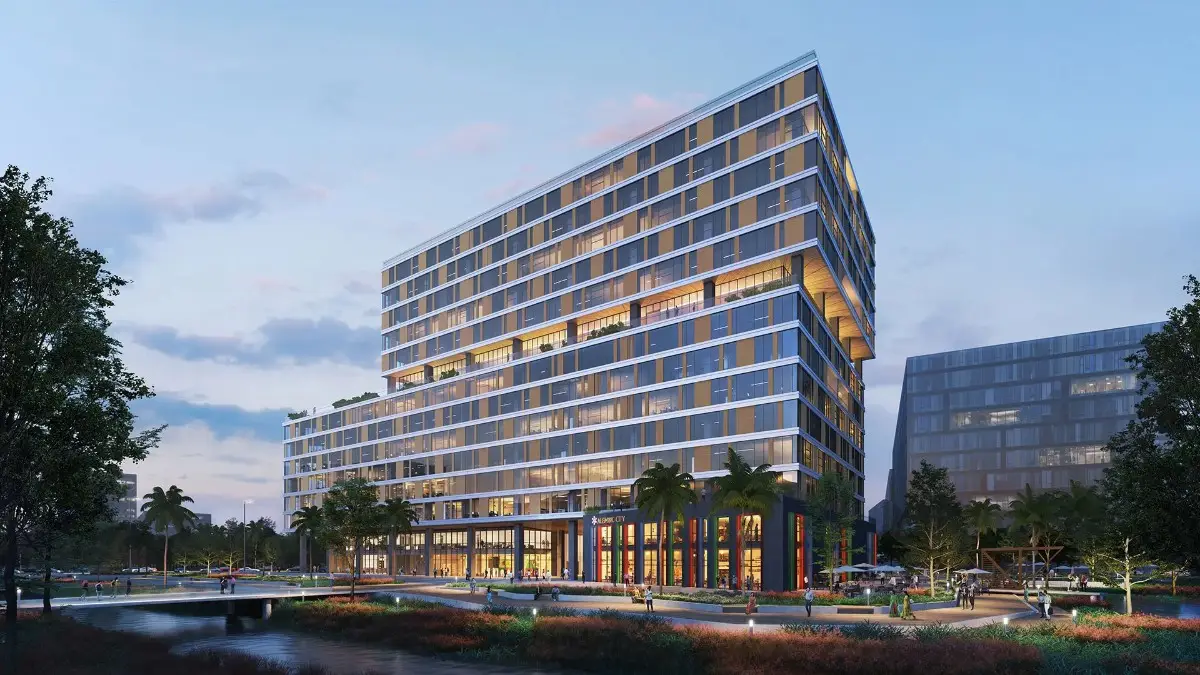
One frame in the set is not Cloud Forest and should not be read as though it were. It shows a large glazed commercial block at dusk with a lit retail frontage at ground level, a water body and a footbridge in front of it, and the Alembic City name over the entrance. A second frame shows a retail and dining pavilion under a steep pitched roof, with cafe tables set out under the trees.
Both belong to the neighbouring development. They are worth seeing, because what is next door shapes daily life, but they are context rather than inventory.
Visiting
Overall construction stood at 31% complete on 15 July 2026, up from 16% in January and 25% in April. The towers' own reported figures at that date were Tower B 16%, Tower C 13% and Tower A 11%. A site visit today shows that stage of the build. Go at a weekday morning peak and again on a weekend, drive the approach from both the east and the west, and stand on the boundary long enough to hear it.
Alt Text and Captions
| Image | Alt text | Caption |
|---|---|---|
| Aerial | Aerial view over Alembic Cloud Forest showing the three towers, the wooded central grounds, the pool and the outdoor sports courts | The grounds from above - Alembic Cloud Forest |
| Aerial, tighter crop | Closer aerial view of the landscaped central grounds and sports courts at Alembic Cloud Forest, Pattandur Agrahara | The central grounds and courts - Alembic Cloud Forest |
| Elevation at dusk | The three Cloud Forest towers lit at dusk above the tree canopy at Kadugodi, Whitefield | Towers A, B and C at dusk - Alembic Cloud Forest |
| Pool, wide | Swimming pool and sun deck at Alembic Cloud Forest, with the timber-louvred amenity building on the left and the towers behind | The pool and amenity terrace - Alembic Cloud Forest |
| Pool terrace | Pool terrace with circular seating islands and a timber deck under the palms at Alembic Cloud Forest | The pool terrace - Alembic Cloud Forest |
| Arrival pavilion | Arrival pavilion and paved forecourt under the coconut palms at Alembic Cloud Forest, Whitefield | The arrival pavilion - Alembic Cloud Forest |
| Master plan | Alembic Cloud Forest master plan showing the three registered Phase I blocks A, B and C, with blocks D and E beyond the boundary line | Master plan - Alembic Cloud Forest |
| Location map | Alembic Cloud Forest location map showing the site beside Alembic City and Alembic Urban Forest, between the Whitefield and Hopefarm Channasandra metro stations | Location map - Alembic Cloud Forest |
| Alembic City frontage | The Alembic City commercial frontage at dusk, on the development neighbouring Alembic Cloud Forest | Alembic City, next door - Alembic Cloud Forest |
| Retail pavilion | Retail and dining pavilion with outdoor cafe seating in the development neighbouring Alembic Cloud Forest | The retail pavilion next door - Alembic Cloud Forest |
All figures on this page are as at 16 September 2026.
Alembic Cloud Forest gallery
Alembic Cloud Forest FAQs
What are maintenance charges at Alembic Cloud Forest?
No monthly maintenance figure has been published for this project by any source that can be verified, and with completion filed for 31 October 2029 such charges would not normally be fixed yet. Figures circulating online for this project are not sourced. Ask the developer what is proposed, and ask when it will be fixed and by whom.
Is Alembic Cloud Forest a good investment?
That depends on figures this page will not invent. No reliable published appreciation rate, rental yield or resale benchmark exists for this project, and the ones in circulation for this micro-market disagree with each other. What can be said is factual: the land is wholly owned by the promoter, no borrowing or mortgage is declared, the completion date has never slipped, the project's complaint record is empty, and over half the inventory has been taken. Do your return arithmetic on written numbers you obtain yourself.
How do I verify the Alembic Cloud Forest registration myself?
Go to rera.karnataka.gov.in and search for PRM/KA/RERA/1251/446/PR/250625/007869, or search under the registered project name Cloud Forest. Check three things - that the promoter reads Shreno Limited, that the completion date reads 31 October 2029, and that the most recent quarterly progress position is more current than anything you have been shown. The construction percentage and the booking position are the figures that go stale fastest here - both are published quarterly, and both on this site are dated 15 July 2026.
Can I visit Alembic Cloud Forest, and what else should I see nearby?
Yes, and you should ask for a site visit before you take anything else on trust. Ask to see Urban Forest on the same trip. It is this promoter's only delivered Bengaluru project, it stands nearby, and walking a finished Alembic building tells you more about workmanship and maintenance than any brochure can.
How do I enquire about Alembic Cloud Forest?
Use the enquiry form on the contact page of this site. A specific question - a configuration, a tower, a floor band, a budget - gets a specific answer far faster than a general callback request does.
Before you book
Ask for a line-itemised cost sheet against a unit number and an area basis, and check the registration yourself at rera.karnataka.gov.in.