
Alembic Cloud Forest Masterplan
The Alembic Cloud Forest masterplan does one thing decisively: it puts 798 homes onto 37,945 sq m — about 9.38 acres — at Pattandur Agrahara, Kadugodi, by building tall and narrow rather than wide and low. Three towers, lettered A, B and C, carry 266 apartments each across 34 registered floors, with no basement anywhere on the site. This page walks through the registered footprint, what the three-tower arrangement does for daily life, what the declared amenity schedule actually contains, the one genuine conflict in the amenity position, and the blocks on the developer's drawing that are not registered.
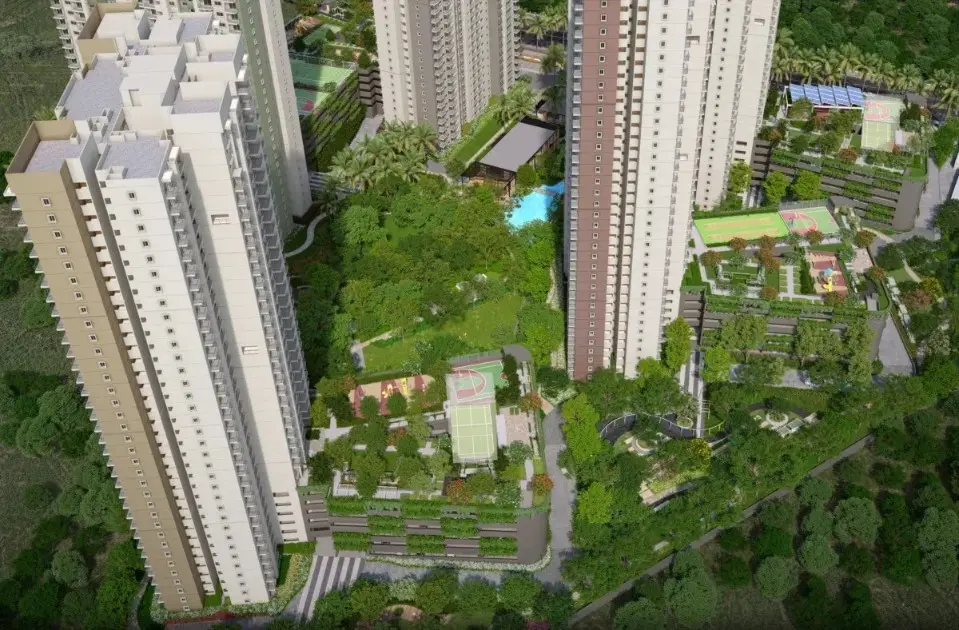
The Registered Footprint
| Parameter | As registered |
|---|---|
| Total land | 37,945 sq m, about 9.38 acres |
| Open area | 29,511 sq m |
| Covered area | 8,433 sq m |
| Towers | 3 - Towers A, B and C |
| Homes per tower | 266 |
| Total homes | 798 |
| Floors | 34 per tower |
| Super-structure slabs | 35 per tower |
| Basement levels | None |
| Tower height | 105.7 m |
| Parking lots per tower | 266 |
| Total parking | 1,041 covered and 24 open against 798 homes |
| Registered completion | 31 October 2029 |
| Status as at 16 September 2026 | Under construction |
Every figure in that table is a registered figure. Where a larger number for this project reaches you from elsewhere, the registered footprint above is what has actually been approved and is what your agreement will be written against. Amberstone Vectra is useful for the site-planning lens because buyers should read open space, movement, parking, and amenity placement as everyday-use details, not brochure decoration.
How the Land Is Split
The parcel divides into 29,511 sq m of open area and 8,433 sq m of covered area. Open ground substantially outweighs covered ground, and that ratio is the masterplan's central decision rather than an accident of the site.
The logic is the standard high-rise bargain, executed here without hedging. Concentrating 798 homes into three tall, tightly footprinted towers leaves the majority of the parcel free for landscape, circulation, sports and services. A low-rise scheme with the same unit count on the same land would have covered far more ground and left far less of it usable.
The bargain has a cost, and a buyer should price it honestly. Height means lift dependence: every trip out of your home, every delivery, every school run and every emergency passes through a vertical core shared with every other apartment in your tower. Ask how many lifts serve each tower and what the service-lift provision is. At 34 floors the answer to that question governs your daily experience more than the landscape plan does.
Three Towers, Evenly Loaded
Towers A, B and C carry 266 homes each and 266 parking lots each. The symmetry is unusual and it is worth noticing.
Even loading means no tower is the oversized one. Lift and lobby demand is identical across the three, amenity pressure is distributed rather than concentrated, and no block carries a disproportionate share of the common-area burden. It also makes the three construction programmes directly comparable, which is why the project's progress is reported tower by tower as well as in total.
For a buyer choosing between towers, the differentiators will therefore not be density or unit count, which are equal, but position on the parcel, orientation, floor band and which boundary your apartment faces. Those are questions for the unit plate, not for the masterplan.
Thirty-four Floors, and No Basement
The registration records 34 floors per tower, with the floor table running from level 0 to level 34, and 35 super-structure slabs. Tower height is 105.7 m. "G+34" is a fair shorthand for that arrangement; "34 floors as registered" is the more precise phrase, and it is the one this page uses.
The genuinely unusual entry is the basement count, which is none.
That single fact does more work than it first appears. There is no excavated substructure on this site, which removes an entire category of construction risk — basement dewatering, groundwater ingress, tanking failures and the long-tail waterproofing defects that dog deep-basement towers in Bengaluru's clay and sheet-rock geology. It also shortens the substructure programme, which is consistent with a project that has moved from earthwork into superstructure.
The consequence a buyer should chase is the parking. The project registers 1,041 covered lots and 24 open lots, and with no basement level those covered lots are necessarily carried at or above ground rather than dug in. That means a meaningful part of the ground plane, or a built deck above it, is given over to parking. Ask the developer exactly where the covered parking sits in relation to the landscaped areas, and whether the amenity ground is at grade or on a deck above the parking. The answer determines how much of the 29,511 sq m of open area is genuinely open at eye level, and it is not a question the registered figures can settle for you.
Parking, in Plain Terms
The registered unit schedule allots one parking lot to every apartment, on every row, without exception. Against 798 homes the project registers 1,041 covered and 24 open lots — more lots than homes, which leaves headroom for visitors and second vehicles.
This is worth being firm about, because parking is a line item that gets renegotiated at the sales desk across this market. One lot per apartment is the registered position. Get your specific lot identified in your agreement, with its location and its type, before you pay.
The Declared Amenity Areas
The registration carries a declared amenity schedule with areas attached. This is what has actually been declared for the project.
| Facility | Declared |
|---|---|
| Outdoor sports | 1,175 sq m |
| Water and sanitation | 855 sq m |
| Parks | 645 sq m |
| Indoor sports | 470 sq m |
| Swimming pool | 310 sq m |
| Power backup | 280 sq m |
| Electricity | 224 sq m |
| Party hall | 84 sq m |
| Gymnasium | Yes |
| CCTV | Yes |
Read down that list and the shape of the amenity programme is clear enough: outdoor sport is the largest single allocation, indoor sport is substantial, there is a pool and there are parks, and the infrastructure lines for water, sanitation, power backup and electricity are declared with real areas rather than left as promises.
The Clubhouse, and the Conflict Worth Knowing About
There is one genuine contradiction in this project's amenity position, and it deserves to be published as a contradiction rather than smoothed over.
The registered amenity schedule declares Club House: No and Community Hall: No. At the same time it declares a party hall of 84 sq m, 470 sq m of indoor sports, 1,175 sq m of outdoor sports, a 310 sq m swimming pool, 645 sq m of parks, a gymnasium and CCTV. The developer's own project page, separately, promises an exclusive clubhouse.
Both positions are on the record. We are not going to average them, resolve them by assertion, or attach a square footage to a clubhouse — no source we would stand behind publishes one, so this page publishes none.
What a buyer should do about it is concrete. Ask for the clubhouse to be named in your agreement, with its area, its position on the sanctioned plan, the facilities inside it and the date it is handed over. A facility that is in the agreement is a commitment you can enforce. A facility that appears only in marketing material is not. That distinction is worth more to you than any figure either side of this conflict could supply.
The Further Blocks on the Developer's Drawing
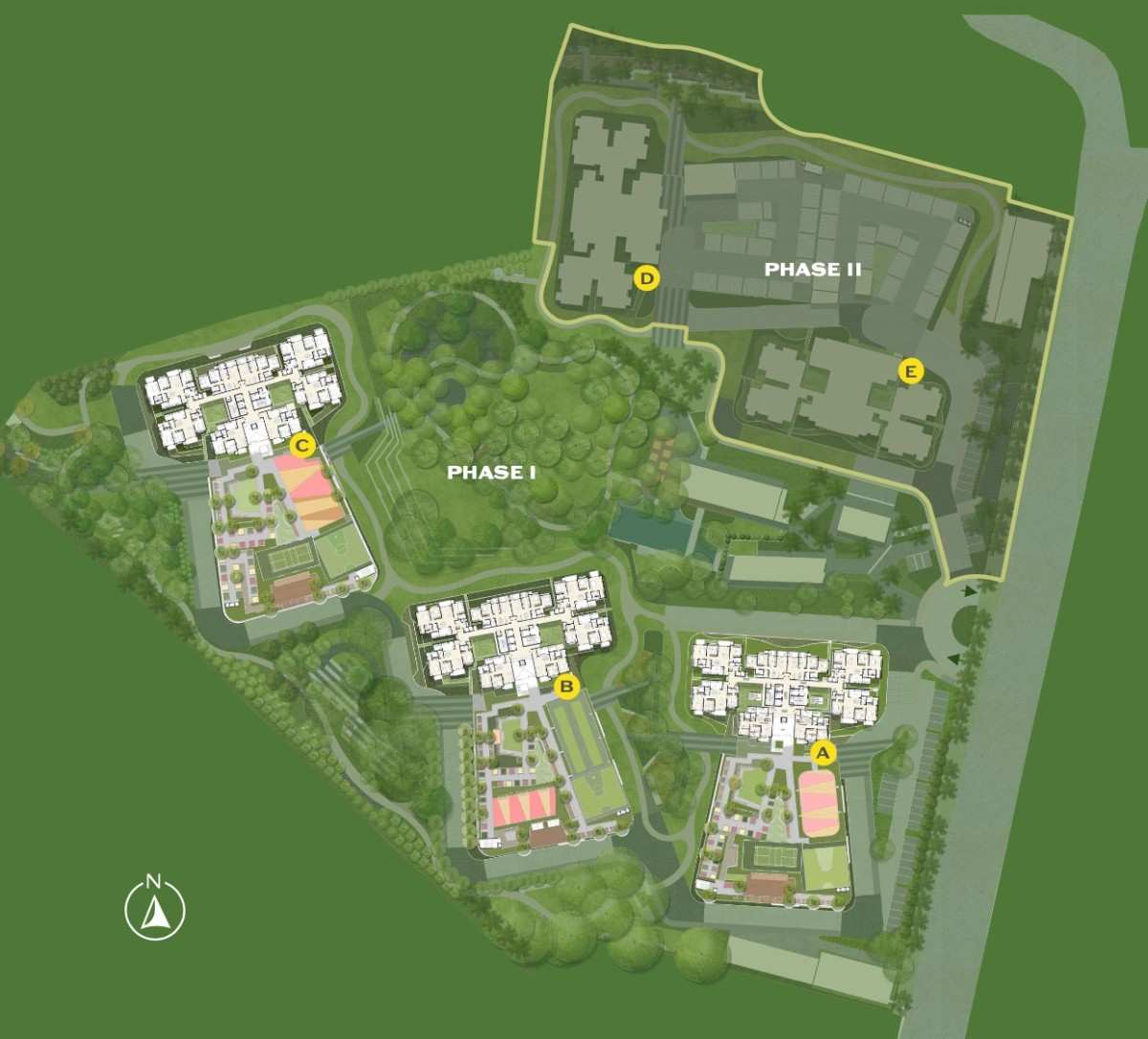
The developer's master plan shows two further blocks, D and E. Neither is registered with Karnataka RERA as at September 2026, and no launch date or unit count has been published.
That sentence is the whole of the reliable position, and it is deliberately short. What it means in practice is this. What you are buying is the three-tower registered project set out above: 798 homes on 37,945 sq m, completing 31 October 2029. Do not price, plan or commit on the assumption that anything beyond it arrives. Do not assume shared facilities with anything unregistered. And be clear-eyed about the other side of it: if further construction does come to this parcel, it will be a working site alongside homes that are already occupied. Ask the developer, in writing, what its intentions are and what protections your agreement gives you.
Where Construction Stands
Progress is reported both for the project as a whole and tower by tower.
| Measure | Position |
|---|---|
| Overall, 15 July 2026 | 31% |
| Overall, 15 April 2026 | 25% |
| Overall, 15 January 2026 | 16% |
| Tower A | 11% |
| Tower B | 16% |
| Tower C | 13% |
The overall figure and the per-tower figures are reported as separate measures and do not reconcile to one another, so read them side by side rather than trying to average the towers into the total. The direction of travel is the useful part: 16% to 25% to 31% across two quarters is steady, unremarkable, real progress on a project whose registered completion date is still more than three years out.
On the commercial side, 434 of the 798 homes were booked as at 15 July 2026, with 364 available.
What Underwrites the Plan
A masterplan is only as good as the balance sheet that has to build it, so the financial position is worth stating.
The registered project cost is ₹881.96 Cr, split as ₹322.17 Cr of land and ₹559.79 Cr of development. The promoter, Shreno Limited, declares no borrowings and no mortgage against it, and owns 100% of the land with no joint-development agreement and no co-promoter. There is no declared litigation on the land, the khata or the property, and there are no complaints recorded against this project.
Those are genuinely strong compliance facts and they are stated here on their own. They are not a guarantee of delivery, and nothing on this page should be read as one. They are what can be verified, and verification is the right standard to hold a project to when handover is 2029.
What to Verify Before You Commit
- Ask how many passenger and service lifts serve each tower, and what the lift-to-apartment ratio works out to at 266 homes.
- Ask where the covered parking sits relative to the landscaped ground, and whether the amenity level is at grade or on a deck.
- Get your specific parking lot identified in your agreement, by location and type.
- Ask for the clubhouse to be named in the agreement with its area, plan position, facilities and handover date.
- Ask which boundary and which orientation your tower and floor band face.
- Check the registration and the project's current position yourself at rera.karnataka.gov.in under PRM/KA/RERA/1251/446/PR/250625/007869.
Registration and Promoter
Alembic Cloud Forest is registered with Karnataka RERA as Cloud Forest under PRM/KA/RERA/1251/446/PR/250625/007869, with a registered completion date of 31 October 2029 that has not been extended or amended. The promoter on that registration is Shreno Limited, CIN U26100GJ1944PLC000345, an Alembic group company and the sole owner of the land. Alembic Real Estate is the group-level brand under which the project is marketed and is not a single legal entity. Verify everything on this page yourself at rera.karnataka.gov.in.
Position as at 16 September 2026.
Alembic Cloud Forest master plan
Alembic Cloud Forest FAQs
Is Alembic Cloud Forest mortgaged or borrowed against?
No borrowing is declared against the project and there is no mortgage on it. The filed project cost is ₹881.96 Cr, being ₹322.17 Cr of land and ₹559.79 Cr of development.
Has the Alembic Cloud Forest completion date ever been extended?
No. The date filed at registration, 31 October 2029, stands unchanged, with no statutory extension, no pandemic-related extension and no modification to the sanctioned plan recorded against it.
Are more towers planned at Alembic Cloud Forest?
The developer's master plan shows two further blocks, D and E. Neither is registered with Karnataka RERA as at September 2026, and no launch date or unit count has been published. Buy the three registered towers on their own merits and do not pay today for what has not been registered.
Does Alembic Cloud Forest have a clubhouse?
This is the one genuine conflict on the project and it is published here as one. The developer's material promises an exclusive clubhouse. The registered amenity schedule affirmatively declares Club House: No and Community Hall: No, while declaring a party hall of 84 sq m, indoor sports of 470 sq m, outdoor sports of 1,175 sq m, a swimming pool of 310 sq m and parks of 645 sq m. No verifiable clubhouse area is published anywhere, so no square footage appears on this site. If the clubhouse matters to your decision, have its scope and its handover date written into the agreement.
What amenity infrastructure is declared for Alembic Cloud Forest?
The registered schedule declares outdoor sports of 1,175 sq m, indoor sports of 470 sq m, parks of 645 sq m, a swimming pool of 310 sq m, a party hall of 84 sq m, water and sanitation infrastructure of 855 sq m, power backup of 280 sq m and electrical infrastructure of 224 sq m, along with a gymnasium and CCTV.
Before you book
Ask for a line-itemised cost sheet against a unit number and an area basis, and check the registration yourself at rera.karnataka.gov.in.