
Alembic Cloud Forest vs Godrej Whitefield: buying to a deadline
Some purchases are made against a calendar. A lease that ends, a school year that starts, a family arriving from abroad: once a date is fixed, everything else on a shortlist becomes secondary to whether the developer can be held to a handover. Alembic Cloud Forest has that date. Its filed completion date is 31 October 2029, filed under Karnataka RERA registration PRM/KA/RERA/1251/446/PR/250625/007869, and the project has been selling since May 2025. The option most often set against it, Godrej Whitefield, holds approximately 20 acres near NH-648 Main Road with about 1.1 million sq ft of disclosed developable area and a March 2026 acquisition announcement, but no launch, no registration and no announced completion date as of July 2026. This page compares the two on the terms a deadline-driven buyer actually uses.
At a glance: Alembic Cloud Forest vs Godrej Whitefield
| Factor | Alembic Cloud Forest | Godrej Whitefield |
|---|---|---|
| Can you buy it today | Yes; launched May 2025 with a live cost sheet | No; pre-launch, no interest window open as of July 2026 |
| Handover on record | 31 October 2029, from a the filed 2029 completion onwards window | Not announced |
| RERA number | PRM/KA/RERA/1251/446/PR/250625/007869 | None issued |
| Approvals | Registered with Karnataka RERA, within BBMP limits | Registration anticipated late 2026 or early 2027 |
| Entry home | 1,337 sq ft 2 BHK at ₹2.07 crore | 2 BHK from ₹1.25 crore, about 1,150 to 1,250 sq ft (indicative) |
| Top of the range | 2,670 sq ft 4 BHK at ₹4.13 crore | 4 BHK from about ₹2.6 crore, 2,450 to 2,900 sq ft (indicative) |
| Rate per sq ft | About ₹15,470 published across every format | About ₹12,270 implied by ₹1,350 crore over 1.1 million sq ft; corridor new launches quote ₹14,000 to ₹16,000 |
| Land and context | 15 residential acres inside a 90-acre working township | About 20 acres of greenfield corridor land |
| Scale | 798 homes, five towers, G+34 | Home and tower count not announced |
| Walk to the metro | Kadugodi Purple Line terminus on foot, operational since 2023 | Same line, but 3 to 5 km to Hope Farm and 5 to 6 km to Kadugodi |
| What is already on site | A preserved orchard and a car-free ground plane | Landscape programme follows at launch |
| Developer | Alembic Real Estate, Alembic Group; Alembic City is its flagship | Godrej Properties, India's largest residential developer by booking value |
Only one of these calendars has dates on it
The Cloud Forest timeline is a matter of record rather than intention. Sales opened in May 2025, registration followed in June 2025, and completion is filed for 31 October 2029. The registration covers three towers, A, B and C and 798 of the 798 homes, which matters more than it sounds: a phased release means the first towers are a defined construction commitment rather than a whole-campus promise stretched across a decade.
The competing parcel is at a much earlier point. The land was disclosed on 18 March 2026, roughly 20 acres near NH-648 Main Road, about 1.1 million sq ft of developable area, revenue potential near ₹1,350 crore. As of July 2026 there is no launch, no registration and no interest window open. Channel pages describing an October 2026 window and an early-2031 handover are not developer statements and should not be planned around.
Add the construction cycle to see what that gap means in practice. If registration lands around late 2026 or early 2027 as anticipated, and a Bengaluru high-rise of that scale runs a normal cycle from there, occupation sits comfortably beyond 2031. Against a filed 31 October 2029, the difference is not months. It is years, and they are years of rent.
Price the rent explicitly, because most buyers do not. Two additional years in a rented Whitefield home at prevailing corridor rents is a material sum, and it is spent before the first EMI on the new house is even earned. The indicative Godrej price bands should always be read alongside the date on which they would actually be available, never on their own.
What a registered number actually lets you enforce
Registration is not a badge on a brochure. It changes the legal shape of the transaction, and the difference is worth spelling out line by line.
- A promoter of record is fixed, so you know which entity you are contracting with.
- The sanctioned plan is on file, so tower count, floor plates and unit areas cannot quietly change.
- Carpet areas are declared format by format under the statutory definition rather than described in brochure language.
- A completion date is declared, and missing it has defined consequences for the promoter.
- Collections run through a designated account, which constrains how buyer money is deployed.
Alembic Cloud Forest carries all of that under PRM/KA/RERA/1251/446/PR/250625/007869, registered in June 2025, and sits within BBMP limits, which also tends to make water and sewerage connections more predictable than on land outside municipal boundaries.
Godrej Whitefield has none of it yet, and that is the normal condition of a pre-launch parcel rather than a mark against a strong developer. Registration is anticipated around late 2026 or early 2027. Until then the tower count, unit mix, sizes, carpet areas and completion date do not exist in enforceable form, and the acreage and developable area come from an acquisition disclosure rather than a sanction. One practical rule follows: if a Karnataka RERA number appears against Godrej Whitefield before its filing, it is wrong. Numbers get borrowed from unrelated projects on aggregator pages far more often than buyers realise, so check on rera.karnataka.gov.in directly.
None of which makes a pre-launch purchase irrational. It means the money at risk should be capped at a written, refundable expression of interest until a certificate exists, and that the published project description should be read as intent rather than as specification.
The orchard is the product, and it cannot be retrofitted
The most durable difference between these two sites is not a specification. It is the trees.
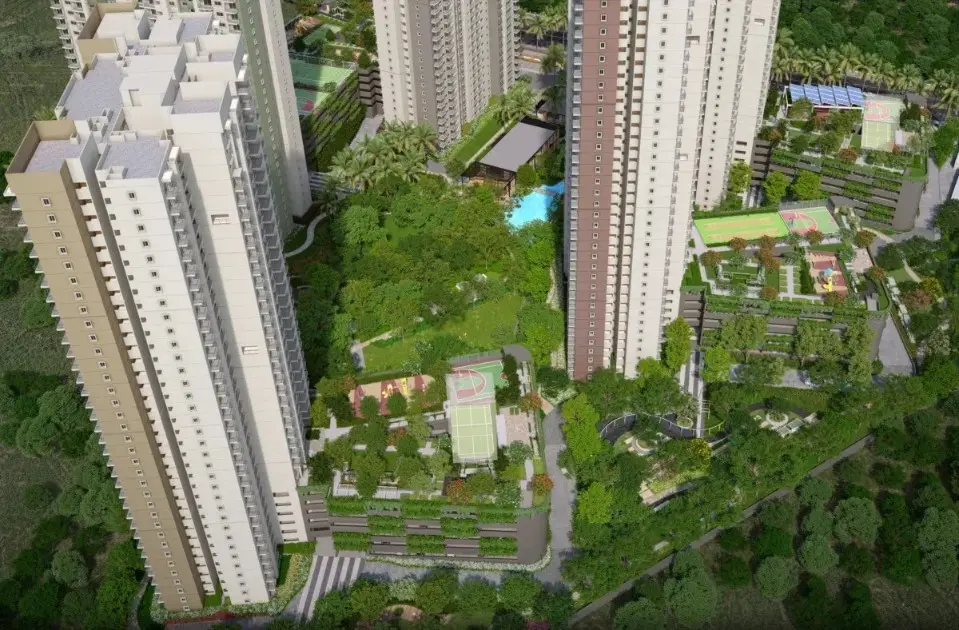
The 15 residential acres here were a working orchard of mature mango, sapota and avocado. The straightforward commercial decision would have been to clear it and maximise floor plate. Instead the towers are placed around the orchard, the ground plane is car-free, and each tower carries a rooftop solar vegetable garden. Whether or not the agrihood label appeals to you, the underlying asset is real: canopy of that age cannot be created on a fresh site inside the ownership horizon of anyone buying today. A sapling planted at handover in 2029 is still a sapling in 2039.
Around the residential parcel, the 90 acres of Alembic City already function as a township, and its commercial precinct houses Google's Bengaluru operations. ITPL is about 3 km away, Nexus Shantiniketan about 4.5 km, Manipal Hospitals ITPL about 4.5 km. This is context that exists rather than context that is scheduled.
The Godrej answer is scale instead of maturity, and it is a legitimate one. Roughly 1.1 million sq ft across about 871,000 sq ft of land is about 1.26 sq ft of building per sq ft of site, a low intensity that leaves genuine room for a central green spine, a sports precinct and separated vehicle movement, all built to that developer's certified-green standard. Read the corridor position and it is clear the two sites will eventually share the same infrastructure. The difference is that one of them has it now and the other will have planted its landscape in 2029.
Density is the honest counterpoint. At 798 homes on 15 acres this is about 89 homes per acre across five towers to G+34. Buyers who want low-rise living should be clear that this is not that.
Reading the rate against the corridor, not against a hope
The published table is flat across formats. The 1,337 sq ft 2 BHK is ₹2.07 crore, the 1,763 sq ft 3 BHK is ₹2.73 crore, the 2,100 sq ft 3.5 BHK is ₹3.25 crore and the 2,670 sq ft 4 BHK is ₹4.13 crore. Every rung sits within about ₹40 of ₹15,470 per sq ft, so there is no discount hiding in a particular format.
Set that against the corridor rather than against a competitor's estimate. Whitefield averaged about ₹13,000 per sq ft in 2026, up roughly 13 per cent in a year. Established gated stock in Hoodi and Kadugodi trades at ₹9,500 to ₹11,000. New premium launches on Whitefield Main Road and toward Varthur quote ₹14,000 to ₹16,000. This project therefore prices inside the new-launch band at a clear premium to older resale, and the fair question is whether the township, the orchard, the walkable terminus and a filed 31 October 2029 date justify that premium over buying resale. For a buyer who wants a new home with an enforceable date, they generally do.
The Godrej numbers are estimates of two different qualities. The indicative ₹1.25 crore 2 BHK implies about ₹10,870 per sq ft, which sits below even the established resale band and is therefore the least likely figure in circulation to survive a launch. The developer's own disclosure, ₹1,350 crore over about 1.1 million sq ft, implies roughly ₹12,270 per sq ft and is the more credible anchor. Both sit below ₹15,470 and both are unproven. The corridor's own new-launch band remains the better guide to where a late-2026 cost sheet actually lands.
Where the twenty acres genuinely win
A comparison hosted on one of the two projects is only useful if it concedes the other's strengths accurately. Three of them are substantial.
- Entry ticket. The indicative Godrej 2 BHK floor of ₹1.25 crore is about ₹82 lakh below the ₹2.07 crore entry here. For a first-time buyer with a hard ceiling that is not a preference, it is the difference between qualifying and not, and there is no format below 1,337 sq ft on this side.
- Land per home. About 1.26 sq ft of building per sq ft of site against 89 homes per acre is a different living density, and it is the kind of difference felt daily: lift waits, parking pressure, how full the pool is on a Sunday morning.
- Developer depth. Godrej Properties booked ₹34,171 crore in FY26, up 16 per cent, its third consecutive year as India's largest residential developer by booking value, with Bengaluru its second-largest market at ₹8,802 crore and FY27 guidance above ₹39,000 crore. Alembic Real Estate is the younger property arm of a group best known for its listed pharmaceutical business, which turns over more than ₹5,000 crore a year. Alembic City is its flagship and its long-term commitment, but the delivery record is shorter.
The counterweight to all three is time. Those advantages are available only to a buyer who can wait for a launch that has not been scheduled, at a price that has not been set. If your horizon is long and your budget is tight, that is a rational bet and the anticipated configurations are worth tracking as the launch approaches. If your horizon is fixed, it is not a bet you can place at all.
Two households, two different right answers
Take the two clearest cases and the decision resolves itself without much argument.
Household A is a couple in their late thirties working in the ITPL belt, with a child starting school in 2030 and a lease they do not want to renew twice more. They need to know when they move in and what it will cost. For them the answer is not close: a registered project with a 31 October 2029 target, a published rate and a released Phase 1 is worth paying roughly ₹3,200 per sq ft more for than an unlaunched parcel. The premium is the price of certainty and certainty is what they are buying.
Household B is a younger buyer with a ₹1.5 crore ceiling and no deadline, currently living with family and paying no rent. A ₹2.07 crore entry is out of range and there is no smaller format available. Waiting for the Godrej launch costs them nothing except opportunity, and their entry ticket could be roughly ₹82 lakh lower. For them, waiting is the correct call, provided they treat the indicative floors as a floor and stay ready for the sheet to print higher.
Everyone else sits between those two, and the tie-breaker is almost always the calendar rather than the rupee.
Before committing to either, do the same four things. Verify the registration number on rera.karnataka.gov.in rather than on any marketing site. Get the complete cost sheet and add GST at 5 per cent, Karnataka stamp duty at 5.6 per cent and registration near 2 per cent, plus floor rise, parking, clubhouse charges and corpus. Read the draft agreement for the possession clause and the delay remedy. And confirm in writing that any pre-launch payment is refundable before it leaves your account.
Comparing Alembic Cloud Forest and Godrej Whitefield? Talk to us.
Our team can share dated cost sheets, current offers and a side-by-side breakdown for both projects so you can decide with real numbers. Most responses arrive within the hour during business hours.
Talk to a Sales ConsultantAlembic Cloud Forest vs Godrej Whitefield - Frequently Asked Questions
When will Alembic Cloud Forest be handed over, and when will Godrej Whitefield?
Alembic Cloud Forest states a filed completion date of 31 October 2029, filed under its Karnataka RERA registration. Godrej Whitefield has no announced possession date because it has not launched; registration is anticipated around late 2026 or early 2027, which places a realistic handover well beyond 2031. Only the first of those dates is enforceable.
Can I compare the prices of the two projects today?
Only loosely. Alembic Cloud Forest publishes a full table from ₹2.07 crore to ₹4.13 crore, about ₹15,470 per sq ft across all formats. Godrej Whitefield has no cost sheet; its indicative floors imply about ₹10,870 per sq ft and its own land disclosure implies about ₹12,270. Comparing a published rate against an estimate is not a like-for-like exercise.
Is Alembic Cloud Forest too dense at 798 homes?
It is a vertical project: 798 homes across five G+34 towers on 15 acres, about 89 homes per acre. What offsets it is the preserved orchard, the car-free ground plane and the surrounding 90-acre Alembic City township. The Godrej Whitefield disclosure of 1.1 million sq ft on about 20 acres implies lower build intensity, but no home count has been announced.
Which is better for a first-time buyer under ₹2 crore?
Godrej Whitefield, if you can wait. The smallest home at Alembic Cloud Forest is a 1,337 sq ft 2 BHK at ₹2.07 crore, so a ₹2 crore ceiling does not reach it. The indicative Godrej 2 BHK floor is ₹1.25 crore, roughly ₹82 lakh lower, though it is market-derived guidance and the launch sheet could print materially higher.
What does the Alembic Cloud Forest registration cover that Godrej Whitefield cannot yet?
A fixed promoter of record, a sanctioned plan on file, carpet areas declared format by format, a declared completion date with consequences for delay, and collections routed through a designated account. Godrej Whitefield has none of these until it registers, which is normal for a pre-launch parcel but limits what a buyer can enforce today.
Should I wait for the Godrej Whitefield launch instead of buying now?
Only if your timeline is genuinely open. Whitefield rose about 13 per cent in the year to 2026 and new premium launches quote ₹14,000 to ₹16,000 per sq ft, so a late-2026 Godrej cost sheet may not sit as far below the ₹15,470 rate at Alembic Cloud Forest as the indicative floors suggest. Waiting also adds years of rent.